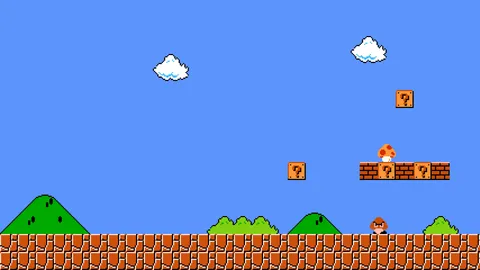
Super Mario Bros. is a platform game developed and published by Nintendo, released for the Famicom in Japan in September 1985 and for the NES in North America in 1985. Players guide Mario — and optionally Luigi in a two-player mode — across eight worlds of side-scrolling levels, stomping enemies, collecting power-ups, and rescuing Princess Toadstool from Bowser. The game rescued the North American video game industry from its 1983 crash, defined the platform genre, and remains one of the most important and influential games ever made.
Super Mario Bros. was designed by Shigeru Miyamoto and Takashi Tezuka and released on 13 September 1985 in Japan, bundled with the Famicom as a pack-in title in North America. It followed the 1983 arcade game Mario Bros. and transformed its single-screen format into a side-scrolling world of eight kingdoms. Mario must traverse the Mushroom Kingdom — its plains, underground tunnels, underwater caverns, and castles — to reach Bowser in World 8-4 and rescue the Princess.
Super Mario Bros. established the grammar of the platform game. Running builds momentum; jumps have arc and hang time; enemies can be stomped, avoided, or bypassed. The Super Mushroom doubles Mario’s size and grants an extra hit; the Fire Flower lets him throw projectiles; the Super Star grants temporary invincibility with its own musical fanfare. Flagpoles end each level, with height at the moment of contact determining the bonus score. Hidden coin blocks reward experimentation; Warp Zones in World 1-2 let players skip to later worlds. The game teaches its rules almost entirely through level design — hazards are introduced in safe contexts before they become dangerous — a technique that has influenced game design education ever since.
Super Mario Bros. sold over 40 million copies on the NES, making it the best-selling video game of its era. It is credited with reviving the North American video game market following the 1983 crash and establishing Nintendo as the dominant force in home gaming for the following decade. IGN ranked it #21 on their 2021 list of the top 100 games; Time ranked it #8 on their 2016 list of the 50 best. The franchise it launched has become the best-selling video game series of all time, with over 800 million units sold. Its iconography — the mushroom, the flagpole, the coin block — is among the most recognisable in popular culture.