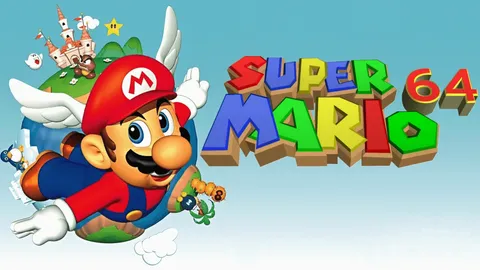
Super Mario 64 is a platform game developed by Nintendo EAD that launched alongside the Nintendo 64 in 1996. As the first fully three-dimensional Mario game, it established the template for 3D platformers and open-world collectathon design that the industry would follow for decades.
Super Mario 64 is a platform game developed by Nintendo EAD and published by Nintendo, released in June 1996 as a launch title for the Nintendo 64. It was the first major console game to place a third-person character in a continuous three-dimensional world, and the first Mario game to move beyond side-scrolling. Directed by Shigeru Miyamoto, it set the template for open-world platforming that the industry would follow for the next twenty-five years.
Bowser has invaded Princess Peach's castle, scattering the Power Stars that grant it energy across fifteen paintings and secret rooms within the castle walls. Mario must dive into those paintings — each one a self-contained world — to recover the Stars, one by one. There is no forced order: the castle opens progressively as Mario's Star count grows, but players can skip entire worlds, find stars out of sequence, and sequence-break freely.
Each of the fifteen courses contains six main Stars plus a hidden one, and the layouts are spacious enough to reward exploration at any angle. Mario's moveset — long jump, backflip, wall kick, ground pound, triple jump, dive — was designed around a fully analogue stick and camera controls handled by a dedicated right-hand button cluster. The precision of the movement, built around holding and releasing buttons in mid-air, gave the game a physical expressiveness that 2D predecessors could not match.
The camera, operated by Lakitu on a fishing pole in-game, was one of the first attempts to solve the problem of player-controlled perspective in 3D space. It does not always succeed — certain angles frustrate — but its ambition set the terms of the problem that every 3D game since has tried to answer. The analogue control, tuned so that stick pressure maps directly to Mario's running speed, remains one of the most satisfying input systems ever designed for a platform game.
Super Mario 64 scored 94 on Metacritic for the Nintendo 64, among the highest ever recorded. It is a fixture on nearly every all-time list, appearing as high as #2 on Time's and #7 on IGN's. Its influence extends to virtually every 3D platformer, action-adventure game, and open-world collectathon that followed, and its movement system continues to be studied and speed-run with extraordinary precision decades after release.