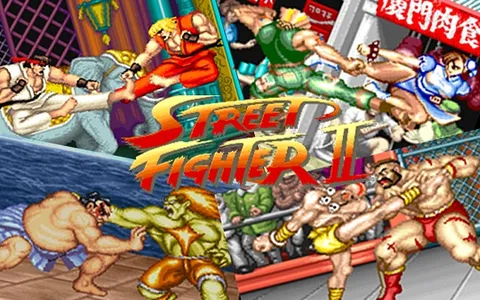
Street Fighter II: The World Warrior is a fighting game developed and published by Capcom, released in arcades in 1991. Eight playable fighters from around the world compete in one-on-one bouts using special moves, combos, and precise timing — and in doing so, invented the competitive fighting game genre as it exists today.
Street Fighter II: The World Warrior was developed and published by Capcom, releasing in arcades in February 1991 before a landmark SNES port in 1992. Players choose from eight world warriors — Ryu, Ken, Chun-Li, Guile, Blanka, Dhalsim, E. Honda, and Zangief — each with a unique fighting style, special moves executed through directional inputs, and a storyline culminating in a battle against M. Bison.
Street Fighter II introduced the mechanics that define the genre: a six-button layout separating punches and kicks by strength, quarter-circle and charge inputs for special moves, a super meter, and a health bar depleted over two or three rounds. The depth concealed within those mechanics — frame data, hitboxes, cross-ups, option selects — kept players studying the game for decades. The SNES port's faithfulness to the arcade original, at a time when home conversions were typically compromised, made it a cultural event: it sold over 6 million copies and drove SNES hardware sales significantly.
Street Fighter II created the competitive fighting game scene. Arcade machines became arenas; players developed terminology — rushdown, zoning, footsies, the neutral game — that persists in fighting game communities today. The Evolution Championship Series (EVO), the largest fighting game tournament in the world, traces its direct lineage to Street Fighter II tournaments in the early 1990s. Every fighting game made since — Mortal Kombat, Tekken, Marvel vs. Capcom, Guilty Gear — exists in the template it established.
Street Fighter II is ranked #14 on Rolling Stone's 2025 list of the 50 Greatest Video Games of All Time. It is the game that built competitive fighting as a genre, a culture, and an esport, and its influence on game design, arcade culture, and competitive gaming is immeasurable.