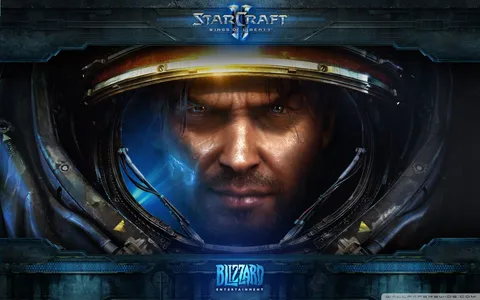
StarCraft II: Wings of Liberty is a 2010 real-time strategy game developed by Blizzard Entertainment, continuing the story of Jim Raynor as he fights against the Terran Dominion and the encroaching Zerg — a landmark in competitive gaming and one of the most acclaimed RTS games ever made.
StarCraft II: Wings of Liberty is the first chapter of Blizzard's long-awaited sequel to the 1998 original, released twelve years later. The campaign follows Jim Raynor, a rebel marshal leading an outlaw band called Raynor's Raiders against Arcturus Mengsk's oppressive Terran Dominion. Woven into the conflict is the return of Sarah Kerrigan — the Zerg-infested Queen of Blades — and an ancient Xel'Naga artefact that may hold the key to the galaxy's survival. The campaign uses the Terran faction and unfolds across dozens of missions set on various planets, with a branching mission structure and a persistent base — the battlecruiser Hyperion — where upgrades and side missions are selected between deployments.
The core RTS loop — gather resources, build structures, produce units, destroy the enemy — is refined to near-perfection. The Terran, Zerg, and Protoss factions each play radically differently: Terrans are mechanically versatile with siege tanks and bio-ball infantry; Zerg overwhelm with numbers and mutation upgrades; Protoss rely on technologically superior but expensive units. The campaign introduces mechanics not seen in multiplayer — hero units, base defence missions, timed objectives, and ally factions — giving it a distinct feel from the competitive mode. Multiplayer became the defining competitive RTS of its era, with Battle.net matchmaking, a robust ladder, and an enormous eSports scene centred in South Korea that helped legitimise professional gaming globally.
StarCraft II: Wings of Liberty received universal critical acclaim on release, scoring a 93 on Metacritic for PC. It was praised for its polished campaign, its extraordinarily deep multiplayer, and for successfully modernising the original without losing what made it great. It won numerous game of the year awards in 2010 from PC-focused outlets and remains the benchmark against which real-time strategy games are judged. Blizzard subsequently released two expansion campaigns — Heart of the Swarm (Zerg, 2013) and Legacy of the Void (Protoss, 2015) — completing the trilogy. The game transitioned to a free-to-play model in 2017.