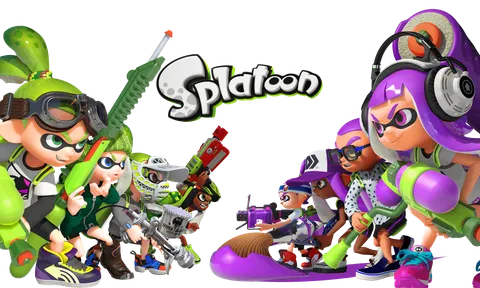
Splatoon is a third-person shooter developed and published by Nintendo, released in 2015 for the Wii U. It introduced a fresh and colourful take on competitive multiplayer, where teams of four players called Inklings battle to cover the arena in their team's ink colour rather than simply eliminate opponents.
Splatoon is Nintendo's first entirely new franchise in years and a bold reinvention of the competitive shooter genre. Released in May 2015 exclusively for the Wii U, it replaced the genre's typical gritty military aesthetic with a vibrant, pop-art world populated by teenage squid-human hybrids called Inklings. The game's central hook — covering territory with coloured ink rather than racking up kills — made it immediately distinct from every other shooter on the market and proved massively appealing to players of all skill levels.
The primary competitive mode, Turf War, pits two teams of four against each other on small, contained maps over three-minute matches. Victory goes to whichever team has painted the greater percentage of the floor — a simple objective that produces surprisingly nuanced tactical play. Inklings can transform into squid form to swim through their own team's ink at high speed, refill their ink tank, and access areas unreachable on foot. This fluid alternation between humanoid and squid form gives the movement a unique rhythm unlike any other shooter.
Ranked modes — Splat Zones, Tower Control, and Rainmaker — add objective-based variety for players seeking a more competitive experience. A single-player campaign, Octo Valley, offers around five hours of puzzle-platformer levels that double as a tutorial for advanced techniques.
The game launched with a modest map and weapon selection that Nintendo steadily expanded through free post-launch updates over the following months, adding new stages, weapons, and game modes at a regular cadence. The Wii U GamePad displays a real-time overhead map of the battlefield, letting players instantly super-jump to any teammate — a clever use of the hardware that adds meaningful strategic depth.
Splatoon received positive reviews upon release, earning a Metacritic score of 81 on Wii U. Critics consistently praised its originality, accessibility, and the infectious fun of its core loop, though some noted the thin launch content and the absence of voice chat. The game was a commercial and cultural hit in Japan in particular, where it sparked a dedicated competitive scene and an extensive merchandise line. It was named to Edge magazine's 100 Greatest Games and is widely credited with reviving the Wii U's sales in its later years. Its success led to two sequels — Splatoon 2 (2017) and Splatoon 3 (2022) — cementing the franchise as one of Nintendo's most important new properties.