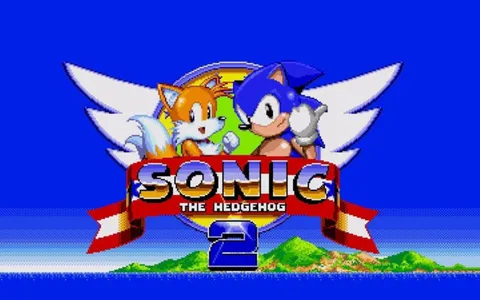
Sonic the Hedgehog 2 is a platform game developed by Sonic Team and published by Sega for the Mega Drive/Genesis, released in 1992. Faster, larger, and more ambitious than its predecessor, it introduced Miles "Tails" Prower, the Spin Dash, and a two-player split-screen mode — and became the best-selling game on the Mega Drive.
Sonic the Hedgehog 2 was developed by Sonic Team — a joint effort between Sega's Japanese studio and the newly formed Sega Technical Institute in the United States — and published by Sega for the Mega Drive and Genesis in November 1992. Yuji Naka led programming while Hirokazu Yasuhara designed the levels, returning to Sonic's world with a larger scope and a new companion: Miles "Tails" Prower, a twin-tailed fox who follows Sonic through every stage.
The game refined the formula of the original in almost every dimension. Eleven zones replaced six, each with two acts and a boss. The Spin Dash — charged by holding down and pressing the action button — gave Sonic instant speed from a standing start, removing the one friction point of the original's momentum system. A two-player split-screen race mode let a second player control Tails competitively across dedicated stages. The Casino Night Zone pinball mechanics, the underwater tension of Aquatic Ruin, and the industrial momentum of Metropolis Zone gave the game a tonal range the original only hinted at.
Sonic the Hedgehog 2 was bundled with the Mega Drive in many markets and sold over 6 million copies, making it the console's best-selling title. Its introduction of Tails established the series' tradition of companion characters, and its level design influenced platform game construction for years. The 2013 remaster by Christian Whitehead, which restored cut content including the Hidden Palace Zone, is considered the definitive version.
Sonic the Hedgehog 2 is ranked #35 on Rolling Stone's 2025 list of the 50 Greatest Video Games of All Time. It remains the high-water mark of the classic Sonic era and one of the defining platform games of the 16-bit generation.