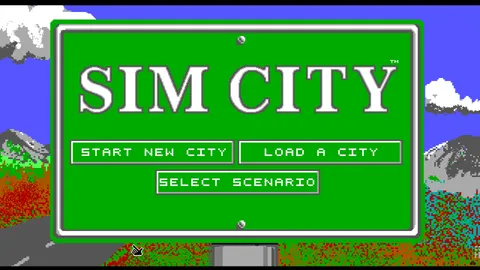
SimCity is the landmark 1989 city-building simulation by Will Wright and Maxis that invented a genre — placing players in the role of mayor to zone land, build infrastructure, and manage a growing city while balancing budgets and disasters.
SimCity arrived in 1989 as something the games industry had never seen: a game with no winning condition, no enemies, and no defined end state. Designed by Will Wright and published by Maxis, it cast the player as the mayor of a blank piece of land, responsible for zoning residential, commercial, and industrial areas; laying roads and power lines; funding police stations, fire departments, and schools; and collecting taxes to keep it all running. The simulation underneath was surprisingly deep, modelling traffic flow, crime rates, pollution, and land values in ways that felt genuinely systemic.
The gameplay loop is one of careful expansion and crisis management. Cities grow organically as citizens (called Sims) move in and demand services, but neglect any system and problems compound — crime rises, residents leave, tax revenue collapses. Periodic disasters, from earthquakes and tornadoes to the infamous Godzilla-style monster attack, force the player to rebuild and rethink. There is no victory screen; the reward is simply a thriving, humming metropolis that you built from scratch.
SimCity was initially turned down by most publishers as "not a game," until Broderbund agreed to distribute it. It became one of the best-selling PC games of its era and spawned one of gaming's most enduring franchises. Critics and players alike praised its open-ended design and educational value — it was adopted in classrooms as a tool for teaching urban planning and economics. TIME magazine and Slant both later placed it on all-time best-games lists, recognising it as one of the most influential designs in the medium's history.
Will Wright went on to apply the same "no-goal simulation" philosophy to The Sims and Spore, but SimCity remains the purest expression of the idea: that a game can be about process, not outcome, and that the most compelling challenge is the open-ended one you set for yourself.