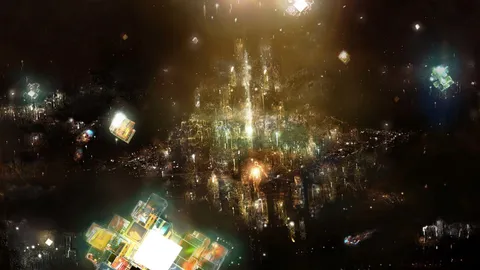
Rez Infinite is a rail shooter developed and published by Enhance Games, released for PlayStation 4 in October 2016. An enhanced remaster of Tetsuya Mizuguchi’s 2001 cult classic Rez, it adds a new open-world area called Area X and full PlayStation VR support. Players shoot enemies to the beat of a pulsing electronic soundtrack, with visuals and music building in intensity as the game progresses — a synesthetic experience unlike anything else in games.
Rez Infinite was directed by Tetsuya Mizuguchi and released on 13 October 2016 as a PlayStation 4 launch title for PlayStation VR. It is a remaster of the original Rez, released in 2001 for Dreamcast and PlayStation 2, which had itself been a cult classic — acclaimed but underselling on initial release. The remaster brought the game to a new generation with updated visuals, a 60fps framerate, and the new Area X, a fully three-dimensional open space that broke from the original’s on-rails structure.
Rez Infinite is a rail shooter in which the player moves through five areas, locking on to enemies and firing in time with the music. The core mechanic is synesthetic: every shot, explosion, and enemy death produces a sound that slots into the electronic score, and the music itself builds and evolves as the player progresses. The player avatar upgrades through a series of visual forms when powered up and regresses when hit, creating a fluid feedback loop tied directly to performance. Area X, the new addition, strips away the rails entirely — players float freely through a vast, abstract space in a sequence that feels more like a music video than a traditional level.
In PlayStation VR, Rez Infinite became one of the most discussed arguments for virtual reality as an artistic medium. The combination of spatial audio, full-body presence, and the game’s audiovisual design produced an immersive experience widely described as unlike anything achievable on a flat screen. Edge ranked it #18 on their 2017 list of the 100 greatest games of all time. A PC version with Oculus Rift support followed in 2017. Mizuguchi has described the game as part of a broader theory of “synesthesia” — the deliberate fusion of sight, sound, and touch into a unified experience — that has informed his work across Lumines, Child of Eden, and beyond.