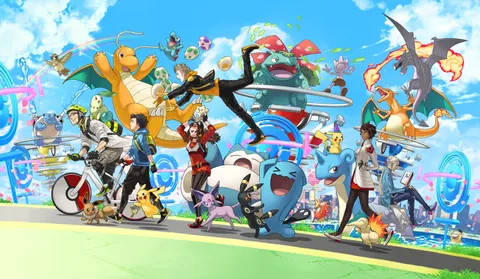
Pokémon Go is Niantic's location-based augmented-reality RPG, turning real-world walking, landmarks, and social play into a global Pokémon hunt.
Pokémon Go launched in 2016 as a mobile game built around a simple but powerful idea: use the player's actual surroundings as the map. Instead of moving through a fictional region with a controller, players walk through their neighborhoods, parks, and city streets to find Pokémon, spin PokéStops, visit Gyms, and join events tied to real locations.
The game combined Niantic's location technology with the immediate appeal of Pokémon collecting. Wild Pokémon appear on a GPS-based map, and players catch them with touchscreen throws while building a roster for evolution, raids, Gyms, and player-versus-player battles. Its augmented-reality camera mode was not the whole game, but it gave the launch its signature image: Pokémon appearing in ordinary streets, offices, classrooms, and landmarks.
Its biggest impact was social. Pokémon Go pushed millions of people outside at the same time, turning plazas and parks into temporary gathering places and making mobile game play visible in public space. Raids, trading, Community Days, and team-based Gym control reinforced that structure over time, giving the game a rhythm of local cooperation and large-scale global events.
Because Pokémon Go is an ongoing live-service game, its design has changed repeatedly through new generations of Pokémon, seasonal events, research tasks, raids, battle leagues, and quality-of-life revisions. It does not have a conventional campaign or completion point, which makes HowLongToBeat-style completion data misleading here; the point is collection, movement, and recurring participation rather than finishing a bounded story.
Few games of the 2010s changed public behavior as visibly. Pokémon Go became a cultural event, a major mobile-business success, and one of the clearest examples of how a familiar game world could be mapped onto the physical world. Its place on IGN's 2019 all-time list reflects not only its mechanics, but the scale of the moment it created.