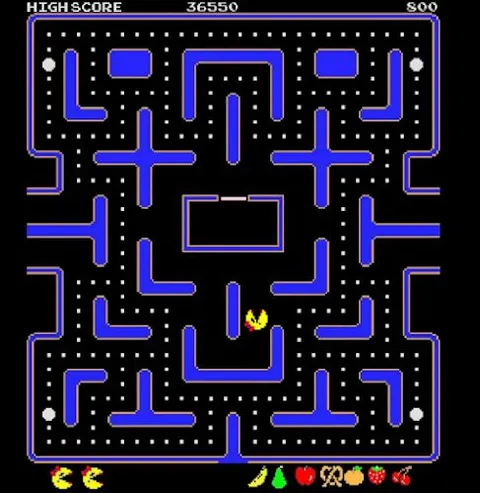
Ms. Pac-Man is an arcade maze game developed by General Computer Corporation and published by Midway, released in 1981. Guiding Ms. Pac-Man through four distinct mazes to eat pellets and evade four ghosts, it refined and expanded on the original Pac-Man in nearly every respect — and became one of the best-selling arcade cabinets in history.
Ms. Pac-Man was developed by General Computer Corporation — a group of MIT engineers who had previously created an unauthorised Pac-Man enhancement kit called "Crazy Otto" — and licensed through Midway Games, the North American distributor of the original Pac-Man. It was released in arcades in January 1981 and became one of the fastest-selling arcade machines ever made.
Ms. Pac-Man introduced four distinct mazes, moving fruit that bounced unpredictably around the screen rather than sitting in a fixed location, and ghosts with improved AI that moved more independently of each other and less predictably than in the original game. Players guide Ms. Pac-Man through the maze eating all pellets while avoiding Blinky, Pinky, Inky, and Sue — temporarily turning the tables by eating one of four power pellets, which allow Ms. Pac-Man to eat the ghosts for a short time. The game cycles through its mazes and increases in speed with each loop.
Where the original Pac-Man had a single maze and predictable ghost patterns that could be memorised and exploited, Ms. Pac-Man's four mazes and improved ghost AI demanded genuine adaptability. It was widely regarded — even by its original developer — as the superior game. Its popularity with female players was notable at a time when arcades were assumed to be exclusively male spaces, and its protagonist remains one of gaming's earliest and most recognisable female characters.
Ms. Pac-Man is ranked #32 on Rolling Stone's 2025 list of the 50 Greatest Video Games of All Time. Over 115,000 arcade cabinets were sold — among the highest totals ever recorded — and the game has been ported to dozens of platforms across four decades.