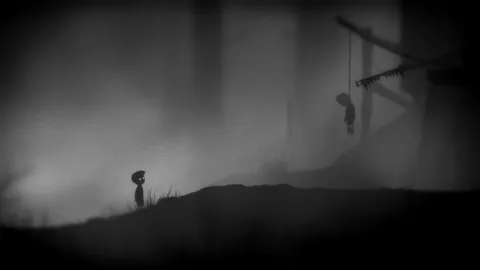
Limbo is a monochromatic puzzle-platformer from Playdead that guides a boy through a shadowy, dangerous world in search of his sister. Its stark black-and-white aesthetic and minimalist storytelling made it a landmark indie title when it launched in 2010.
Limbo is a puzzle-platformer developed by Danish studio Playdead, released in 2010 as an Xbox Live Arcade exclusive before arriving on other platforms. The game follows a nameless boy who wakes at the edge of Hell and ventures through a hostile, monochromatic world searching for his missing sister. With no dialogue, no text, and no explicit explanation, the story is left almost entirely to the player's interpretation.
Limbo is a side-scrolling platformer built around physics-based puzzles. The boy can run, jump, push objects, and interact with simple machinery. Puzzles escalate steadily in complexity, introducing gravity switches, rope mechanics, and hostile creatures. Death is frequent and often brutal — the game uses trial-and-error as a core mechanic, with instant respawns that keep the pacing tight. The whole experience lasts around three to four hours.
Limbo's visual identity is its most distinctive feature. Everything is rendered in deep blacks, greys, and whites, with a grainy film texture and a subtle depth-of-field blur that gives the world a dreamlike, unsettling quality. Environmental hazards — bear traps, saw blades, giant spiders — are rendered with the same quiet detachment as the landscape itself. The sparse sound design reinforces the mood: ambient drones, distant mechanical sounds, and silence used deliberately throughout.
On release, Limbo was widely praised as a breakthrough for indie game artistry. Critics highlighted its atmosphere, its confident visual style, and its economy of design as evidence that games could communicate emotionally without exposition. It won numerous awards, appeared on countless end-of-year lists, and is credited with helping establish the market for premium indie titles on consoles. It ranks #69 on Edge's 100 Greatest Games (2017) and has influenced a generation of atmospheric platformers.