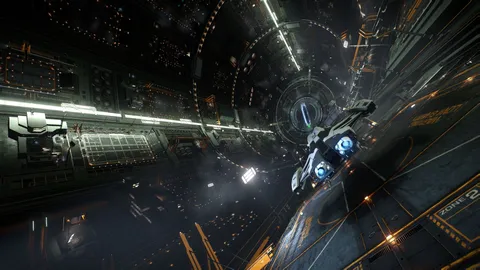
Elite: Dangerous is Frontier Developments’ 2014 space flight simulation, rebuilding the classic Elite formula as a persistent Milky Way of trading, exploration, combat, and faction politics.
Elite: Dangerous was developed and published by Frontier Developments and released for Windows in December 2014 after a successful crowdfunding campaign. It revived one of PC gaming’s foundational open-ended space series, translating the 1984 original’s promise of freeform life among the stars into a modern online simulation with a full-scale model of the Milky Way.
Players begin with a small ship and a modest credit balance, then choose their own path through a galaxy of star systems, economies, stations, factions, and hazards. Trading rewards reading supply and demand across markets. Mining turns asteroid belts into resource routes. Exploration sends commanders into uncharted space to scan stars, planets, and biological discoveries. Combat ranges from piracy and bounty hunting to faction warfare, with flight assists, power management, hardpoints, and ship loadouts giving dogfights a technical edge.
The game’s structure is deliberately open-ended. There is no conventional campaign endpoint, and progress is measured through money, reputation, ship ownership, ranks, discoveries, engineering upgrades, and personal goals. Solo play exists inside the same broad simulation, while open and private group modes bring other players into the same galaxy. That mix makes it less a mission list than a spacefaring career platform, where the story often comes from the route a player plots and the risks they accept along the way.
Its most striking achievement is scale. The galaxy contains hundreds of billions of star systems, most procedurally generated from astronomical data and simulation rules. Travel, docking, supercruise, hyperspace jumps, fuel management, and planetary approaches turn distance into something felt rather than merely displayed. Even routine actions, like lining up with a mailslot or deciding whether there is enough fuel to push one jump farther, give the game a tactile sense of piloting.
Elite: Dangerous appears at #87 on Edge’s 2017 list of the 100 Greatest Videogames. Its inclusion reflects how distinctive it remains: a demanding, systems-heavy space simulation that values patience, navigation, and self-directed ambition as much as combat spectacle. For players willing to meet it on those terms, it offers one of the medium’s most convincing versions of living in a vast, indifferent galaxy.