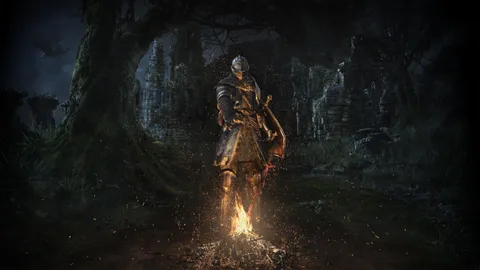
Dark Souls is a punishing action RPG from FromSoftware set in the dying world of Lordran. Renowned for its cryptic lore, interconnected level design, and demanding combat, it defined an entire genre and permanently changed how difficulty is discussed in games.
Dark Souls was developed by FromSoftware and directed by Hidetaka Miyazaki, released in 2011 as a spiritual successor to Demon's Souls. Set in the decaying kingdom of Lordran, the game places the player in the role of an Undead warrior on a vaguely defined pilgrimage through a world slowly consumed by darkness. Story is delivered almost entirely through item descriptions, environmental detail, and brief NPC dialogue — demanding active interpretation rather than passive reception.
Combat in Dark Souls is methodical and weight-driven. Every swing, roll, and block consumes stamina, and enemies punish greed and inattention without mercy. Death is frequent, and each death costs accumulated souls — the game's combined currency and experience points — which can be recovered from the spot of death but are lost permanently on dying again. This loop of risk and recovery defines the experience. The game features a wide range of weapons, armour, spells, and build paths, encouraging multiple playthroughs with different approaches. Multiplayer is woven into the fabric of the world: players can leave messages for each other, briefly see the ghosts of others' deaths, summon allies for co-op, or be invaded by hostile players.
Lordran is one of the most celebrated examples of interconnected world design in games. Areas flow into one another without loading screens, shortcuts reveal themselves as loops back to earlier locations, and the geography rewards exploration and spatial memory. Each zone has a distinct visual identity — from the gothic ruins of Undead Burg to the subterranean horror of Blighttown — while functioning as part of a coherent whole. Boss encounters punctuate the journey with encounters that range from oppressive to spectacular.
Dark Souls was a critical and cult success on release, growing into one of the most influential games of the 2010s. It ranked #2 on Edge's 100 Greatest Games (2017), #80 on IGN's Top 100 (2021), and #25 on Slant's 100 Best (2020). It holds a Metacritic score of 89 on both PlayStation 3 and Xbox 360. The "Soulslike" subgenre it popularised — characterised by punishing difficulty, deliberate combat, and environmental storytelling — has since become one of the defining categories of modern game design.