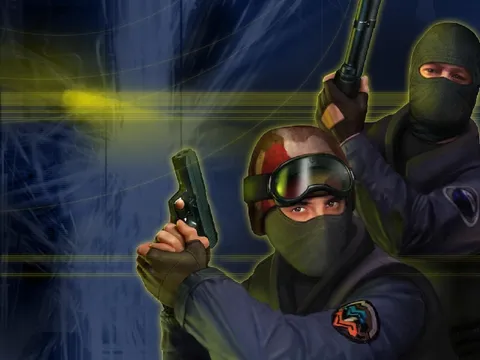
Counter-Strike is a multiplayer first-person shooter developed by Valve, released in 2000 as a standalone retail game following its origins as a Half-Life mod. Pitting teams of terrorists against counter-terrorists across objective-based maps, it became one of the most-played competitive games in history and defined the template for tactical shooters for decades.
Counter-Strike began as a Half-Life mod created by Minh "Gooseman" Le and Jess Cliffe in 1999 before Valve acquired the project and released it as a standalone retail game in November 2000. Its premise was simple: two teams — terrorists and counter-terrorists — compete across rounds with a single life per round, no respawns, and a shared economy that rewards winning and punishes losing.
What made Counter-Strike different from every other shooter of its era was consequence. A single bullet could end your round. Positioning, communication, and economy management mattered more than reaction time alone. Players bought weapons and equipment at the start of each round with money earned from kills and objective completions, creating a strategic layer — the "eco round," the "force buy," the "save" — that gave matches a rhythm closer to chess than a traditional shooter.
Counter-Strike essentially invented modern esports infrastructure. LAN tournaments, professional teams, skill-based matchmaking, dedicated training maps — the conventions the industry takes for granted were pioneered in Counter-Strike communities in the early 2000s. CS:GO (2012) and CS2 (2023) brought millions of new players, but the tactical DNA established in 2000 remained unchanged: five-versus-five, bomb defusal, one life per round.
Counter-Strike is ranked #31 on Rolling Stone's 2025 list of the 50 Greatest Video Games of All Time. Now in its CS2 iteration, it remains one of the most-watched and most-played competitive games in the world, more than two decades after its original release.