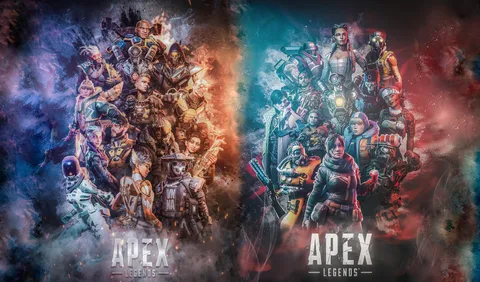
Apex Legends is Respawn Entertainment's free-to-play battle royale, built around squads of hero characters, sharp movement, and team communication.
Apex Legends launched in 2019 as a surprise entry in the Titanfall universe, trading Titans and wall-running for a squad-based battle royale format. Players choose from a roster of Legends, each with tactical, passive, and ultimate abilities, then fight to be the last team standing across large maps filled with weapons, armor, attachments, and shifting encounter zones.
The game stood out immediately because of how much it refined battle royale flow. Its contextual ping system made it possible to communicate enemy positions, loot, destinations, and strategy without voice chat, while respawn beacons gave eliminated teammates a way back into the match. Those systems quickly became reference points for multiplayer design well beyond Apex itself.
Respawn's first-person combat also gave Apex Legends a distinct feel. Sliding, climbing, zip lines, balloon redeploys, and character abilities all support fast repositioning, while the gunplay keeps the weight and readability associated with the studio's earlier shooters. The result is a battle royale where team fights often hinge on movement, timing, and ability combinations as much as pure aim.
As a live-service game, Apex Legends has changed continuously through new Legends, weapons, maps, modes, events, and balance revisions. That ongoing structure means its exact state has shifted across seasons, but the core appeal has remained the same: a competitive shooter built around readable squads, expressive hero kits, and high-tempo combat.
Apex Legends became one of the most important battle royale games of its generation by proving the genre could support character-driven team roles without losing immediacy. Its launch, communication tools, and movement-forward combat made it a major 2019 release and a natural choice for later all-time lists covering modern competitive games.